Episode 5 of the Deep Down Show pairs two subjects that rarely share a stage in Bengali business conversations: startup metrics and personal grief. Guest Avelo Roy, founder of Kolkata Ventures and a core member of the Bengal Business Council, tells host Barun that a family tragedy, two deaths in an accident and his parents' separation, left him as the only male member of his family. That is what actually pulled him back from a self-built life in the US to Kolkata, not a career calculation.
The conversation moves between two registers throughout. One is practical: patents filed in college, a 73% success rate Roy claims for the startups Kolkata Ventures incubates, and his argument for why Bengali entrepreneurs need a dedicated support network. The other is personal and spiritual, built largely around the Bhagavad Gita and Krishna's counsel to Arjuna, which Roy treats not as background reading but as a working framework for how he responds to failure, loss and purpose.
Note on this piece: the source audio for this episode is heavily degraded in transcription, so this article stays deliberately narrow, sticking to points Roy states clearly rather than reconstructing anything the transcript only gestures at.
Patents in college, then a return no one expected
Roy studied at Cambridge University before moving to the US to study engineering, and says that is where his entrepreneurial track began. While still in college, he and two co-founders filed three patents together. Around the same period, he travelled to Canada for close to fourteen business-plan competitions, and says that exposure gave his early venture validation as well as its initial seed funding. He later built a company of his own and obtained his US work visa, an H1B, under that company rather than through an employer.
By his own account, that US chapter was a life he had built entirely from scratch, with family, friends and a career already in place. The tragedy that upended it, the accident that killed two family members and the separation of his parents, meant he was the only remaining male member of the family, and he says there was no real choice left but to return to Kolkata and take charge of the household and family responsibilities his mother could no longer manage alone.
What makes the return notable, in his telling, is that it wasn't a soft landing. Almost nobody in Kolkata knew what he had built in the US; his professional history, his network, even basic proof of his own credentials had no local audience. He describes effectively starting from zero again, having to establish himself on social media and rebuild recognition from scratch in a city where his American success meant nothing on its own.
Kolkata Ventures and the 73% claim
Kolkata Ventures, the incubation centre Roy founded, is what he built out of that restart. He states its success rate for incubated startups at 73%, a figure he sets against a national average he puts at around 5%. He attributes the gap to process: Kolkata Ventures, he says, follows an incubation methodology derived from Stanford University, the kind of structured design-thinking and resourcing approach he associates with Silicon Valley's own success rate.
He frames the difference as less about talent and more about exposure. Kolkata Ventures, in his description, deliberately gives founders the kind of structured guidance and resources that Silicon Valley-adjacent founders take for granted, rather than leaving them to figure out fundraising, product validation and scaling on their own.
Why Bengal Business Council exists
A recurring theme is the case Roy makes for the Bengal Business Council, where he is a core member alongside running Kolkata Ventures. His argument is that other business communities in India, he names Marwari and Gujarati networks specifically, have long operated with exclusive internal support systems that help their own members, while Bengali entrepreneurs historically had nothing comparable. The Bengal Business Council, as he describes it, was built to close that gap and back Bengali-owned businesses the same way.
He extends that into a broader claim about Kolkata's startup economy: many startups there, he says, including ones incubated from Ranaghat, Murshidabad, Sikkim and Darjeeling, are bootstrapped and already profitable, hiring people and paying taxes, in contrast to startups in hubs like Bangalore or Gurgaon that he says are still running losses. Part of that, he argues, comes down to cost: he estimates salaries in Kolkata run around 25% lower than in Bangalore, alongside lower living expenses generally, which he frames as an advantage for building a sustainable business rather than a burn-fuelled one.
Krishna's counsel and the shape of his spirituality
The episode's spiritual thread leans heavily on the Bhagavad Gita, specifically Krishna's counsel to Arjuna on the battlefield. Roy returns repeatedly to the idea that Arjuna's fight was not undertaken for personal ambition but as duty. He also invokes the scale the Gita and Puranic tradition use to describe existence, citing figures like 8.4 million species of life and a Kali Yuga said to span roughly 433,000 years, less as claims he is verifying than as illustrations of the tradition's sense of scale that he says reframed his own problems.
He also distinguishes between sattwik, rajoshik and tamosik qualities of action, though the transcript here is too degraded to summarise the specifics reliably beyond confirming that the distinction is part of how he frames choices, both spiritual and professional. Separately, he describes fielding calls from people in real distress and says he feels a responsibility to respond rather than treat it as someone else's problem; he connects this to a sense of purpose that doesn't depend on having children of his own, since he says he already has many people he mentors and cares for in that way.
The name Avelo, and what failure is for
One of the episode's more concrete anecdotes is about Roy's own name. He explains that "Avelo" is derived from Thomas Alva Edison's middle name, Alva, and treats that connection deliberately: Edison, he points out, failed repeatedly before successfully inventing the lightbulb, and Roy uses that as a personal touchstone for his own approach to setbacks. He also references a venture, started by a family member rather than himself, that eventually had to shut down after real investors lost their money entirely, and uses it to make a blunter point about entrepreneurship: you will fall, repeatedly, and the only real requirement is getting back up each time.
On education, Roy is critical of what he calls the rote-learning ("mukhosto biddha") habits of the Indian system compared to what he frames as a more innovation-oriented approach in American education, and says he would like to start his own college someday.
Who is Avelo Roy
Avelo Roy is a serial entrepreneur, Founder & MD of Kolkata Ventures, and a core member of the Bengal Business Council. He studied at Cambridge University before moving to the US for engineering, where he built a company, filed three patents with two co-founders while still in college, and obtained his own H1B visa through that company. He is a guest lecturer across several IITs, IIMs and US universities.
Why this conversation matters
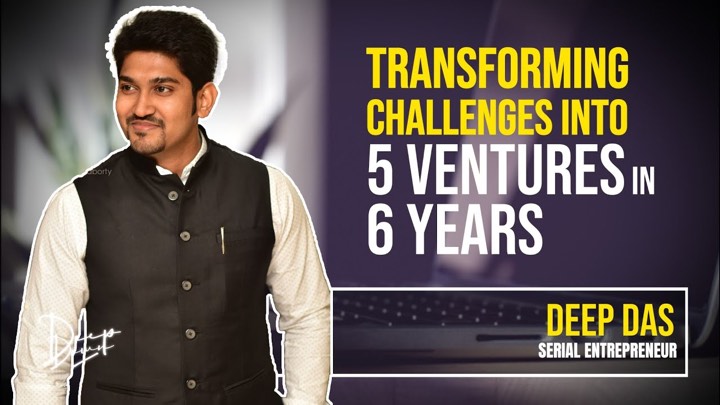
Most startup conversations on Bengali podcasts stay inside the business frame: funding, scaling, hiring. This one is unusual for how openly Roy ties his professional rebuild to a personal loss he didn't choose, and for treating the Bhagavad Gita as a working tool rather than a footnote. It sits well alongside the Bengal Business Council's broader case for Bengali entrepreneurship made in the Subhashis Dutt episode, and alongside Deep Das's account of building multiple businesses from nothing, though Roy's version leans harder into what happens when the plan itself falls apart. For a more direct take on the spiritual side of the conversation, Janardan Ghosh's episode covers similar ground on the difference between spirituality and organised religion.
Roy's own framing, borrowed from Edison by way of his own first name, is the simplest summary of the episode: failure isn't the opposite of the eventual result, it's usually just what comes before it.
Frequently asked questions
Who is Avelo Roy?
Avelo Roy is a serial entrepreneur and the Founder & MD of Kolkata Ventures, an incubation centre. He is a core member of the Bengal Business Council and a guest lecturer at several IITs, IIMs and US universities.
Why did Avelo Roy return to India from the US?
He tells Barun that a tragic accident took the lives of two family members, and his parents had separated, leaving him as the only male member of his family. That forced him to return to Kolkata to look after his mother and take on family responsibilities he otherwise would not have had to.
What success rate does Kolkata Ventures claim for its startups?
Avelo Roy states a 73% success rate for startups incubated through Kolkata Ventures, contrasting it with what he describes as a roughly 5% national average. He attributes this to following an incubation process he says is derived from Stanford University's methodology.
What is the Bengal Business Council?
It is a network built to support Bengali entrepreneurs specifically, and Avelo Roy is a core member. He explains that communities like Marwari and Gujarati business groups have long had their own exclusive support networks, and that the Bengal Business Council was created to give Bengali-owned businesses a similar kind of backing.
How does Avelo Roy connect spirituality to entrepreneurship?
He draws heavily on the Bhagavad Gita, particularly Krishna's teaching to Arjuna about performing one's duty rather than acting from personal desire. He frames both his business setbacks and his personal losses through that lens.
Where does the name 'Avelo' come from?
He explains that his name is derived from Thomas Alva Edison's middle name, Alva. He uses Edison's many failed attempts before inventing the lightbulb as a personal metaphor for how he approaches failure in his own ventures.