Introduction
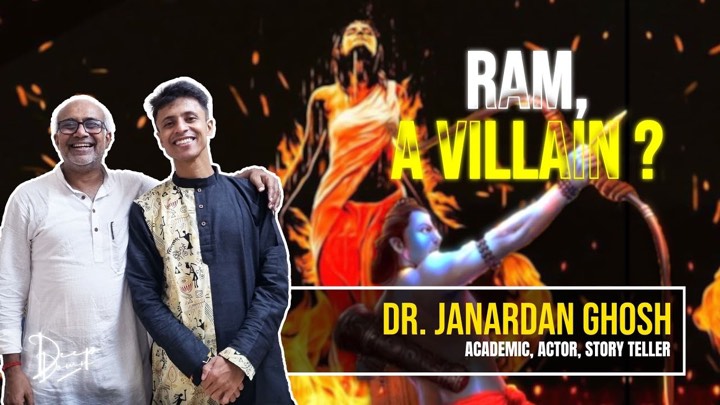
Episode 2 of Deep Down Show brings host Barun a guest the show would return to years later for a conversation on the Ramayan: Dr. Janardan Ghosh, theatre-maker and academic, who draws a firm line between spirituality and religious observance. This first meeting with him runs across two parts, recorded as one long sitting and released a few weeks apart — the first on finding a passion through theatre, the second turning to a bigger question: is it better to be spiritual, or religious?
The two halves are really one conversation. Ghosh's own life supplies the bridge between them — a boy in Dhanbad who fell for cinema and the stage, a young man who chose theatre over the safer path everyone expected of a "good student," and later a scholar who found his way to the Ramakrishna Mission. By the time the discussion turns explicitly to spirituality in part two, Ghosh has already spent part one showing what a life organised around inner conviction, rather than convention, looks like in practice.
Finding a passion in theatre, not a syllabus
Ghosh's love of performance goes back to school in Dhanbad, where he grew up watching Charlie Chaplin and Laurel and Hardy in the school's AV room. Like many students expected to head toward science and engineering, he describes taking an early detour away from that track. It was in college, at Presidency, that theatre took over — he began organising productions and, through a friend, was introduced to actor-director Anjan Dutta.
Working alongside Dutta shaped how Ghosh thinks about acting itself. He recalls a production written by Dutta, a Bangla stage adaptation drawing on West Side Story (itself a modern take on Romeo and Juliet) called Pati Premer Goppo, and describes Dutta as one of the most distinctive actors of Bengali cinema in that period — not for heavy dialogue, but for his restraint: knowing how to hold a pause, and how much a moment can say by staying silent rather than speaking. Ghosh names this quieter, natural style as something he consciously carried into his own idea of what theatre could be, and it fed directly into Oglam, the theatre organisation he founded — which he sums up not as a drama club but as, in his words, an organisation meant to give life meaning.
Choosing theatre over a safe career
The passion came at a cost. Ghosh recounts that his wife set a condition before their marriage: he needed a stable job. That pushed him into a government career he describes candidly as something he took on for security rather than love — and, later, as something that started to feel confining, keeping him tied to postings away from the theatre and academic life he actually wanted.
Eventually, he made the switch that gives the episode its title. A mentor at the Ramakrishna Mission encouraged him to pursue a PhD full-time; Ghosh calls his guide there a brilliant scholar, published with houses like Oxford University Press and Routledge, and someone from whom he learned rigour and attentiveness. Leaving the government job behind for that path is the pivot the first part of the episode builds toward — proof, in Ghosh's own telling, that a passion pursued seriously can eventually become a life's work rather than a hobby squeezed around a "safe" job.
Is it right to be spiritual, or religious?
Part two opens with the question the episode is named for, and Ghosh is direct about not answering it from scripture. His distinction: every person, regardless of whether they call themselves a believer or an atheist, carries an inner energy — a "spirit" — that comes through in whatever they do, whether that's dancing, engineering, practising medicine, or making films. That inner spirit, and how a person's own effort expresses it, is what he calls spirituality.
Religion, in his framing, is the outward shape built around that same spirit — a format, complete with its own rules and rituals, the way different filmmakers might use the same content but a different design. Because the underlying spirit is shared, he argues, the world's conflicts over religion are really fights over format, not over the spirit itself — people rarely go to war over the inner quality religion is meant to protect, but over its outer rules and symbols. Practising a religion well, he adds, still matters in a practical sense: honesty, cleanliness and how you treat others are the external discipline of religion, but what that discipline is meant to cultivate on the inside is the spiritual part.
Meditation, Patanjali and Vivekananda
Asked how meditation actually works, Ghosh turns to Patanjali, the sage credited with compiling the Yoga Sutras and its eight limbs — yama, niyama, asana, pranayama, pratyahara and the stages that follow. He describes meditation not as a single trick but as the practice of quieting the mind's constant disturbances, the restlessness the Sutras address directly.
He repeatedly invokes Swami Vivekananda to make the point practical: if Vivekananda could meditate for hours, Ghosh argues, the same potential — a "divine quality" — exists in everyone, waiting to be manifested rather than assumed absent. He paraphrases Vivekananda's own call to see strength rather than weakness in oneself, summed up in the line he repeats: strength is life, weakness is death. To underline that this is not blind faith, Ghosh points to two examples: Vivekananda's well-documented conversation with the scientist Nikola Tesla, which he says reads as thoroughly scientific rather than mystical, and the well-known account of the young Vivekananda testing his own guru, Ramakrishna, again and again before accepting his teaching rather than believing on faith alone. Ghosh also uses the same instinct — testing an idea rather than accepting it outright — to criticise what he sees as a contemporary education system that discourages students from questioning, holding up Archimedes' restless curiosity as the kind of instinct he thinks schools should be protecting instead of suppressing.
Who is Dr. Janardan Ghosh
Dr. Janardan Ghosh is the founder of Oglam Theatre and an academic associated with the Ramakrishna Mission, where he completed his PhD after leaving a government job. He grew up in Dhanbad, began performing and organising theatre while in college at Presidency, and worked closely with actor-director Anjan Dutta early in his theatre career. He later returned to Deep Down Show for a separate conversation on the Ramayan, discussed in Ramayan: Controversial Sides.
Why this conversation matters
Taken together, the two parts of this episode make an unusual pairing feel natural: a conversation about following a creative passion against family and social pressure, followed by a conversation about what actually anchors a person once they've made that choice. Ghosh's answer to both is the same idea in different clothes — that there is an inner spirit or conviction worth listening to, whether it shows up as a pull toward the stage or as a personal sense of the sacred, and that the outer forms life offers — a stable job, a named religion — are worth taking seriously without mistaking them for the thing itself.
For another side of Ghosh's thinking, see Ramayan: Controversial Sides. For a related look at choosing an unconventional creative path, see How to Become a Poet, and for spirituality intersecting with career choices, see Avelo Roy: Kolkata Ventures.
Frequently asked questions
Who is Dr. Janardan Ghosh?
He is a theatre director and founder of Oglam Theatre, and an academic associated with the Ramakrishna Mission, where he pursued his PhD. He is also a trained actor who has performed with Anjan Dutta's theatre productions.
What is Oglam Theatre?
Oglam is the theatre organisation Ghosh started while he was a college student. In the episode he describes its purpose in a line: an organisation meant to give life meaning, not simply a group that stages plays.
How did Anjan Dutta influence Janardan Ghosh?
Ghosh worked closely with actor-director Anjan Dutta early in his theatre life, including a Bangla stage adaptation drawn from West Side Story called Pati Premer Goppo. He credits Dutta's natural, pause-driven acting style, rather than heavy dialogue, as something he learned from directly.
What does Dr. Janardan Ghosh say is the difference between spirituality and religion?
He describes spirituality as an inner energy or 'spirit' that every person expresses through whatever they do, whether that is dancing, engineering or medicine. Religion, in his framing, is a format or design built around that same spirit, and different religions are simply different formats around a shared core.
What does he say about meditation and Patanjali's Yoga Sutras?
He refers to Patanjali as the sage who compiled the rules of yoga into the Yoga Sutras, including its eight limbs, and describes meditation as the practice of stilling the mind's constant disturbances rather than a single technique.
Why did he leave his government job?
He describes taking up a government job partly because it was a condition his wife set before their marriage, but says the posting eventually felt confining because it kept him away from theatre. He later left it to do a PhD and take up academic work connected to the Ramakrishna Mission.
What does he say about Swami Vivekananda?
He cites Vivekananda's idea that people carry a divine strength within themselves that they must manifest rather than assume they lack, summed up in the line he repeats: strength is life, weakness is death. He also points to Vivekananda's documented conversation with Nikola Tesla as an example of spiritual ideas discussed in scientific terms.