
Somewhere in the middle of this episode, Dr. Prabir Basu describes a patient who comes in saying his marriage is four years old and there is no child. A few questions later the complaint has become "I can't perform", then "I ejaculate too early", then "my erection isn't right" — and finally, after Basu establishes that the erection is in fact fine, the real diagnosis surfaces: performance anxiety. "দেখছো তো পুরো গেমটা কিভাবে চেঞ্জ হচ্ছে," he says. See how the whole game changes. The man was never really ill in the body, only in fear — and in having nobody to ask.
That is the subject of Episode 22 of the Deep Down Show, recorded, as host Barun admits, as a "dream project" he had chased for a year and a half. Basu is a urologist, andrologist and uro-oncologist practising in Kolkata — the male equivalent, as Barun puts it in the intro, of the gynaecologist women can at least talk to. The conversation is unscripted (Basu says he was invited the day before), often funny, and unusually frank for a বাংলা পডকাস্ট: erectile dysfunction, premature ejaculation, masturbation, NoFap, nightfalls, varicocele, Viagra, testosterone, the fertile window and sperm banking, all inside seventy minutes.
This article lays out what Dr. Basu actually said, section by section, in plain language. One note before you read on: it reports the views of one doctor in one conversation and is not medical advice. If anything here describes you, the doctor's own repeated instruction applies — go and see a doctor.
"Solo activity without education leads to accidents"
Barun opens with a story from two and a half weeks earlier. A woman asked him what he was studying next; he told her one of his two current research topics was sex before marriage. Her reaction — why would that need researching? — is, he says, the taboo in action. Why is sex still such a forbidden subject here?
Basu's first answer is a joke with an edge: if they say the word "sex" too many times, YouTube will hand the channel a yellow dollar sign, so "let's use education" instead. Then the serious version:
আমরা লজ্জায় কিছু বলতে চাই না। কিন্তু আমরা সবাই এ নিয়ে খুবই ইন্টারেস্টেড, এক্সাইটেড এবং অ্যাক্টিভ।
Dr. Prabir Basu
We are too ashamed to say anything, and yet all of us are interested, excited and active. Activity without education, he argues, leads to accidents, and some of those accidents are hard to come back from. He describes depression, relationships that break, and couples who reach a point where even the next relationship becomes difficult. In his estimate almost every man in Bengal carries some sexual dysfunction of one kind or another; most are, in his phrase, sexually illiterate but sexually excited. Perhaps eight out of ten Bengali men have some problem, he suggests, and two are the "alpha males" who don't.
How men actually arrive at the clinic
Nobody, Basu says, walks in and announces that he has had a bad habit for fourteen years. The script is always indirect: a wife or girlfriend, a marriage of four years, no child, a partner who is unhappy and has said "get yourself checked or I'm leaving". Only when he asks whether proper vaginal sex has taken place does the "little problem" come out, and even then it arrives as শীঘ্রপতন, premature ejaculation, before it turns out the erection is fine and the fear is the illness.
একটা ছেলের কাছে গিয়ে বলা যে মশাই আমার হচ্ছে না — সেটা যেন বুকের পাটা লাগে।
Dr. Prabir Basu
For a man to go to another man and say "it isn't happening" takes real courage, he says; the male ego, the alpha ego, is in all of us. Barun adds what he found while collecting questions from his own friends: girls at least talk to their mothers, or ring a friend at night. Boys never phone a best friend and ask "Basu, this is happening to me, what do I do?" The subject is খিল্লি, mockery, and the mockery is done before a boy can open his mouth. After failing twice with a girlfriend who has said something cutting, the conviction sets in: it will never work again.
Basu's patients, meanwhile, arrive having consulted Google and ChatGPT, convinced they have testicular cancer. The neighbour will laugh, the office will laugh, the parents are unthinkable, the wife is already scolding, the in-laws are out of the question. So they ask a chatbot, which, he points out, only answers exactly what you type. "এই যে এডুকেশনের কতটা অভাব" — that, he says, is how deep the lack of education runs.
Snake oil on the Baruipur train
The gap gets filled by the wrong people. Basu describes a man hanging from a crowded train to Baruipur who sees a phone number painted on a wall, or on a public toilet, promising a cure. He goes. He is given an oil — "snake oil, what oil, I don't know myself" — rubs it in enthusiastically and gets an erection. What he does not know is that the oil contains steroids, and exogenous steroids depress sperm production. The man who came with four childless years now has an added infertility problem, from an ingredient he never knew he was using, because a hospital reception desk felt too humiliating: "the receptionist will at least laugh."
The man who suffers, Basu says, cannot even cry — there is nobody to cry to — and each wrong turn tightens the trap.
Two friends, one girlfriend and 400 mg of Viagra
The episode's most repeated story is about self-prescribed sildenafil. Two friends, Basu says, share the same girlfriend. One took 100 mg. The other reasons that since the girlfriend is the same and his friend performed on 100, he needs 200. Then 300, then 400. He turns up at the clinic with a red face, a hot head and chest pain, having been asked by the girlfriend whether he was having a heart attack. The starting dose, Basu notes, is 25 mg, and a chemist won't sell you 25 because he "knows 25 won't work", so you walk out with 100. And the girlfriend, told that the 100 gave him half an hour, wants forty minutes more.
Barun asks what the drug actually is. Basu tells the origin story: Pfizer in America was developing a heart medicine, a vasodilator for cardiac patients, and the men taking it kept reporting that their erections had become firmer and asking for more. It turned out to increase penile blood flow as well as cardiac. Viagra, in his words, is a cardio medicine being used as an andro-medicine for its side effect. Barun adds what he had heard — that the company considered pulling it back, the patients refused, and Pfizer's stock boomed — and Basu's point follows: it acts on your heart too. A 20-year-old's heart and a 60-year-old's are different, and a horse that is whipped again and again eventually stops running.
His prescription is not to read pharmacology before taking a tablet, but supervision. Viagra is not paracetamol; it is not an over-the-counter drug. If a blind date is tomorrow, Barun summarises, the answer is an andrologist today — not an escalating stack of 200, 300, 400.
On Indian herbal supplements — shilajit, ashwagandha and the like — Basu is positive but precise. They act, he says, by calming the hormonal environment: if you are permanently braced for a slap from your girlfriend, your cortisol is "at the ceiling" and you will never get an erection. Herbs bring that down slowly and without side effects and raise libido over time. They will do nothing by tomorrow night.
What causes erectile dysfunction, and why the heart is listening
Basu sorts ED by cause. The most common by far in young men is psychological: the performance anxiety of a man who has failed three times and expects to be slapped on the fourth. Around ninety per cent of young men who come to him with the complaint, he says, fall here. The second is hormonal, and he insists it is not just testosterone, whatever the gym trainer says about biceps that turn into a টিকটিকি at home: sleep and melatonin, gut health and serotonin, desire — all of it feeds erectile function.
Then comes age. At fifty he looks for testosterone deficiency; older men on heart medication simply have less blood flow. The warning he wants younger viewers to hear is anatomical. The coronary artery, he says, is four or five times wider than the penile artery, so the penis goes soft five or six years before the heart blocks.
এই ৩০-৩৩ বছরের ছেলেরা যদি ইরেক্টাইল ডিসফাংশনে ভোগে, দেখা গেছে ১০ বছর পরে হার্টেরও প্রবলেম দেখা দিচ্ছে।
Dr. Prabir Basu
Men of 30 to 33 with erectile dysfunction, he says, have been seen to develop heart problems ten years later. Stress in the 25-to-35 years — job stress, relationship stress, in-laws, wife, girlfriend — hits the heart and the penile blood flow together.
Masturbation: "a double-edged sword on a public platform"
Barun asks the question his audience most wants answered: হস্তমৈথুন, masturbation — good or bad? Basu says outright that this is a very hard thing to say on a public platform. Subscribers' parents are watching; he once said "once a week" on another podcast and the comments called him a bad doctor.
What he offers instead is physiology and a string of cases.
- The breast-milk analogy. A mother who stops feeding for a few days will still drip milk. Secretions happen; if they are stored, the pressure lands on the prostate, and chronic prostatitis follows — testicular pain, pain at the anus, burning on urination, burning after ejaculation. Nightfalls, in other words, are normal, whatever a boy with dark circles and "drying hands" believes.
- NoFap at 14. Boys of 14 and 15 come to him — one 12-year-old came with a friend and asked to talk without parents, which Basu refused, because they are adolescents — saying their friends have agreed to do NoFap but they are having nightfalls. At their age, Basu says, he did not know such a culture existed; now it arrives by Instagram reel.
- Prone masturbation. A young man with erection trouble traced it back to sitting on his grandfather's leg and swinging as a small child. He later rubbed himself face-down against a pillow, and the point of stimulus shifted from the glans to the base of the penis. A partner stimulates the tip, nothing happens, and both are frightened. No tablet will supply a missing stimulus; the partner has to be told where it is. If a man discovers this at 40, Basu says, he may never get it back.
- Hand-grip syndrome. A boy in the bathroom with a new video and a mother shouting that the school bus has arrived learns to finish in two minutes with a hard grip. With a girlfriend the environment is warm, slow and different; she may need ten minutes, he is done in one, and he calls it premature ejaculation. Basu's advice is practical: take your time, use a moisturiser, and imagine the conditions of a vagina rather than a hurried hand.
- Veno-occlusive disease. An erection, he explains, needs arterial inflow and a mechanism that traps the venous outflow. Excessive, injurious masturbation can damage that mechanism; the erection comes and drops, comes and drops. Medical treatment is difficult, and the end of that road is a penile implant — a solid silicone rod or an inflatable device — in men who are still young.
His conclusion is conditional, not moral: masturbation is not bad if done properly. It becomes a problem when it is linked to addiction — when nothing happens without a new video — and when it injures tissue or trains the body for the wrong environment. And if you have a partner, he asks, why would you need it?
Sex education starts from home
Barun remembers the reproduction chapter (জনন) in the life-science syllabus being skipped in school. Basu says it is taught now, but children learn from reels long before the syllabus reaches them, and parents should be talking to them anyway. His instruction to fathers is blunt: look at your son's penis; check whether the foreskin retracts. A boy with tight phimosis, he says, typically finds out from a girlfriend — "your skin doesn't pull back" — when a preputial massage or moisturising and a visit to a urologist years earlier would have settled it.
সেক্স এডুকেশনটা স্টার্টিং হবে হোম থেকে।
Barun
নট অনলি সেক্স — সেক্সুয়াল অর্গান। হাউ টু কিপ ইট ক্লিন, হাউ টু কিপ ইট হেলদি।
Dr. Prabir Basu
Sex education starts at home, Barun says; not only sex, Basu answers, the organs themselves — how to keep them clean and healthy. Just as breast self-examination matters for women, testicular self-examination matters for men.
That leads to varicocele, which he says he now sees in a whole group of men aged 20 to 25 with testicular pain. They arrive with an ultrasound report saying epididymo-orchitis, or a prescription for a filariasis drug, or a diagnosis of hydrocele and a recommended operation — none of which, in his telling, was the problem. The testis sits outside the abdomen because sperm and testosterone production need a cool environment; an artery brings blood in and veins carry it out. Long hours on a vibrating motorbike, heavy deadlifts and squats since boyhood without tight support, and constant straining on the toilet dilate those veins. His self-check: stand in front of the mirror, see whether the left testis hangs noticeably lower than the right, and feel for a rope-like, দড়ি দড়ি texture above it. If it is there, go to a doctor. Left alone, he says, both testosterone and sperm production suffer; the story ends four or five years later with a childless couple, a wife whose tests are normal, a semen report reading oligo-astheno-teratospermia or azoospermia, and IVF as the only option — the moment when it could have been fixed long gone.
Does size matter?
Basu's answer is a qualified yes. Micropenis exists, and can have a hormonal cause among others. But the real question is whether the partner reaches orgasm; good sex is a win-win in which both are satisfied, and a man who finishes and leaves will not make his partner happy today or tomorrow. As a rough figure for Bengali men he puts an ideal erect length at about four and a half inches; he does not know, he jokes, about Nigerians. "সাইজ ম্যাটার, বাট রিলেটিভ কনসেপ্ট" — size matters, but it is a relative concept.
How often, when, and how long
Asked how often a married couple should have sex, Basu says it depends on the couple, and that four or five times a week is perfectly good. The more useful answer is about timing for couples struggling to conceive, especially where ED and infertility have run together for years. The fertile window is the middle of the cycle: if a period ended on 31 March and the cycle is 24 days, days 10, 11 and 12 are when there are more eggs. More sperm meeting more eggs raises the chance of pregnancy, so that is when frequency should be highest — even if the sperm count is low.
How to last longer, Barun's "hottest" question, is deferred to a possible part two. The short version Basu gives is that medicine is not the only help: diet, exercise and sleep come first.
Semen retention, athletes and NoFap
Barun asks about gym-goers being told not to ejaculate. Basu separates that from NoFap. Semen retention, he says, is a real practice among top athletes and swimmers before major Olympic events, who are told to abstain for seven days; boxers, professional or amateur, don't have sex for two days before a bout. A Virat Kohli will play well regardless, but for rising athletes retention appears to sharpen focus and productivity. That, he says, is where NoFap culture comes from, and ব্রহ্মচর্য is an important part of Indian philosophy — productivity can skyrocket. Whether any individual can actually keep it up is, he says, a different matter.
Diet, sleep and plastic: testosterone without injections
Basu's own admission that he carries a belly leads into the biology: subcutaneous fat at the waist converts testosterone to oestrogen. So the targets are BMI, fat percentage and carbohydrates — while accepting that Bengalis will not give up rice. Push protein and healthy fats: ghee, good paneer (not the palm-oil kind), whey, fish, meat and eggs. Resistance training — deadlifts, heavy lifting — raises growth hormone, which lifts testosterone indirectly. No testosterone injections, however hard the gym trainer pushes.
Then sleep. Seven to eight hours of sound sleep, he says, beats any quantity of dates and walnuts; the people who "do nothing but sleep" are the ones who are sexually active. Barun confesses to three hours the night before. For night-shift workers the circadian rhythm has to be deliberately rebuilt.
And the environment: drinking from plastic bottles, microwaving food in plastic boxes, and the BPA and microplastics that come with them push the body towards oestrogen. Cola spikes insulin and lowers testosterone. Basu points out that he asked Barun for a glass rather than the plastic bottle on the table. None of this shows in a day — but it is, he says, what stops you needing 400 mg of Viagra later.
Late marriage and the sperm bank
Barun raises the millennial and Gen Z pattern of postponing marriage until the flat and the car are in place. Basu does not tell anyone when to marry; he describes the consequence. Earlier generations married at 16 or 18; now two classmates marry each other at 32, in a world with pollution, pollutants in food and sky-high stress, and there is no time for sex and no baby when there is.
২০ বছর আগে কেউ এই নিয়ে পডকাস্টই করেনি। দরকারই ছিল না। আজকে পডকাস্ট হচ্ছে, লোকে দেখছে, কারণ এখন দরকার আছে।
Dr. Prabir Basu
Twenty years ago nobody made a podcast on this, he says; there was no need. Now there is, because the environment and the whole life cycle have changed. What is in our hands: reduce stress, fix sleep, drop the plastic bottle and the cola, eat vegetables.
For those who can afford it, a sperm bank is a concrete option. Basu describes the man leaving for two years in Germany, unsure what the food and beer will do, who freezes a sample at an IVF centre before he goes; the 32-year-old who otherwise faces donor sperm; and, more seriously, men about to start chemotherapy, cancer drugs or immunosuppressants for conditions like arthritis. Frozen sperm is not the same as fresh, but if it is banked while healthy it can be used later. The cost depends on the centre, and he suggests asking an IVF centre directly for a quote.
Who is Dr. Prabir Basu
Dr. Prabir Basu is a urologist, andrologist and uro-oncologist based in Kolkata; the episode description credits him with more than fifteen years of clinical practice in general surgery and urology. He has a YouTube channel of his own, which Barun says had far fewer subscribers when he first found it in early 2024. Basu says he is 50 and intends to keep seeing patients until 70. He works night duty; Barun tracked him down at a hospital after one such shift because there was no phone number to be found, and jokes that he had been "stalking" him for a year and a half. The episode was booked the day before it was recorded, with no script.
Why this conversation matters
Barun calls Deep Down Show the first Bangla talk-show podcast and calls this episode a dream project; it is also, he says, unfinished. Basu stopped at seventy minutes on a promised forty, with the question of lasting longer held back for a part two that, both men say, depends on the comments.
The reason the episode matters is the one Basu keeps returning to: men in Bengal suffer sexual problems alone, get their information from a wall on the Baruipur line, a chemist counter or a chatbot, and turn up years later with a story that has moved from "no child" to infertility caused by steroid oil, or from a friend's Viagra to chest pain. Almost every case in the episode — the 14-year-old with nightfalls, the boy with phimosis, the young man with varicocele — is one that a conversation at home or one early clinic visit could have changed.
If the episode makes you recognise yourself, its advice is consistent: don't self-medicate, don't let the mockery decide, and see an andrologist or urologist. The society series on this site continues with Nandini Bhattacharjee on men's rights and marriage law and Gourav Banerjee on self-defence. Short clips from this episode — on masturbation, varicocele, Viagra's origins, semen retention and size — are on the DDS Clips channel.
This article summarises one doctor's remarks in a podcast. It is not medical advice and is no substitute for a consultation; any diagnosis or treatment mentioned here should be pursued only with a qualified doctor.
Frequently asked questions
Is masturbation good or bad, according to Dr. Prabir Basu?
Basu says the question is hard to answer on a public platform, but his position is that masturbation is not bad if done properly, and that if you have a partner you don't need it. It becomes harmful when it is tied to addiction, injures penile tissue, or trains the body for the wrong stimulus — as in prone masturbation against a pillow or the hurried 'hand-grip' habit that later shows up as premature ejaculation.
Are nightfalls harmful?
No, according to Basu. He uses the analogy of a breastfeeding mother who stops feeding for a few days and still leaks milk: the body produces secretions, and if they are stored they press on the prostate and can cause chronic prostatitis, with testicular and anal pain and burning on urination. Nightfalls — even the three a week one patient complained of — are the body doing its normal job.
Why does Dr. Basu warn against taking Viagra without a prescription?
Because it was designed as a heart drug. He tells the story of Pfizer's vasodilator for cardiac patients that turned out to increase penile blood flow, and of two friends who shared a girlfriend and escalated from 100 mg to 400 mg until one arrived with chest pain. The starting dose is 25 mg, chemists routinely hand out 100, and although a 20-year-old's heart is not a 60-year-old's, even a strong horse whipped again and again eventually tires.
What is varicocele and how can a man check for it?
Varicocele is dilation of the veins draining the testis, which Basu now sees in many men aged 20 to 25 with testicular pain. He blames long hours on vibrating motorbikes, heavy deadlifts and squats without support, and chronic straining on the toilet. His self-check: stand before a mirror, see whether the left testis hangs clearly lower than the right, and feel for a rope-like texture above it. Untreated, he says, it can reduce testosterone and sperm production and end in infertility.
What does Dr. Basu recommend for raising testosterone naturally?
Lower belly fat, because waist fat converts testosterone to oestrogen; raise protein and healthy fats (ghee, good paneer, whey, fish, meat, eggs) and cut carbohydrates; do resistance training, which raises growth hormone; sleep seven to eight hours; fix the circadian rhythm if you work nights; and avoid plastic bottles, microwaved plastic containers and cola. He is firmly against testosterone injections.
When should a couple trying to conceive have sex most often?
In the middle of the menstrual cycle, Basu says. His example: if a period ended on 31 March and the cycle is 24 days, days 10 to 12 are when ovulation is highest. More eggs meeting more sperm raises the chance of pregnancy, so frequency should be concentrated then — especially for couples where erectile dysfunction and infertility have run together for years.
Is this episode's advice a substitute for seeing a doctor?
No. The episode reports one doctor's remarks in an unscripted conversation, and Basu himself repeatedly tells listeners not to self-medicate from Google, ChatGPT, chemist counters or roadside phone numbers. If any of the problems described sound familiar, his advice is to see an andrologist or urologist.
Clips from this episode
 Masturbation: right or wrong? A urologist answers
 What is varicocele? Cause and cure
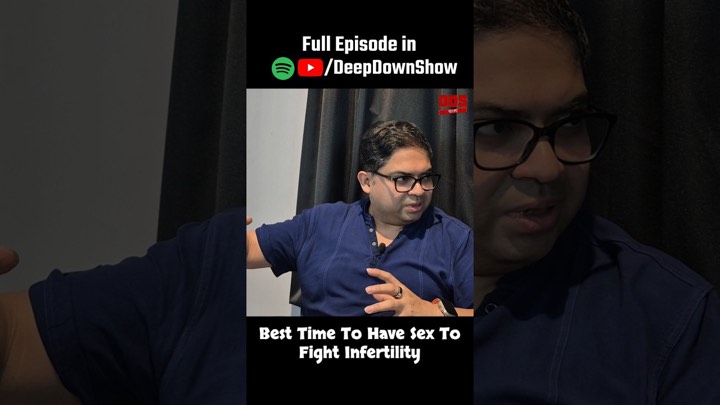 Best time to have sex to fight infertility?
 Why was Viagra actually invented?
 Sex education should start from home
 Semen retention and NoFap for athletes
 Performance issues in bed
 Does size really matter?
 Men don't talk about their sexual issues
 Highlights of the episode