# Akash Pyne's Ravanayan: Was Ravan Truly a Villain?
Everyone else is chanting "Jai Shri Ram" — so why pick Ravan? That is the question Barun opens with in this tenth episode of Deep Down Show, and it is the one Akash Pyne has built an entire book around. Pyne is a Bengali novelist who has written half a dozen books, and the one under discussion, Ravanayan, retells the Ramayan from the side of the man usually cast as its villain.
The conversation is not a devotional retelling. It moves through textual history, genealogy, and regional variants of the epic, and it keeps circling back to a single method: treat the Ramayan not as one fixed scripture but as a "mahakavya" — a great epic assembled across generations by many hands, in the same way the Mahabharata carries its Adi Parva and later additions. Pyne says a work of this scale could not have come from a single author sitting down once; it grew the way Vyasa's epic did, through continuation and revision over a long stretch of time.
That framing lets Pyne do the thing the book is built on: hold up several competing versions of the same events — Sita's birth, Ravan's abduction of her, the Lakshman Rekha — and ask which one the reader is prepared to believe.
Many Ramayans, many theories
Pyne repeats early on that there is no single, authoritative Ramayan. Alongside Valmiki's Sanskrit original, regional retellings grew up across the subcontinent, each shifting emphasis and sometimes plot. As an example, he cites the Sri Lankan king Dhatusena's Sanskrit poem, known as the Janakiharan, which carries a version of Sita's origin story rarely heard in Bengal.
In that account, as Pyne tells it, an astrologer warns Ravan that a daughter born to him will bring about his family's destruction. Soon after, black clouds gather over Lanka and omens appear the day the child is born; on his guru Shukracharya's advice, Ravan has the infant set aside rather than raised as his own. Years later, King Janak finds a baby girl while ploughing his field — which is how she comes to be called Sita, "furrow" — and raises her as his daughter, unaware of her origin. It is, Pyne is careful to say, one interpretation among several, not something the book asks readers to accept as literal history.
Ram and Ravan as Aryan and Anarya
A second thread running through the episode reads the Ram-Ravan conflict as a symbol of an older struggle. Pyne argues that Aryan groups moving into the subcontinent came into conflict with the Anarya — the region's earlier inhabitants — over territory across north, central and western India and beyond, into present-day Afghanistan, Pakistan, Bangladesh, Nepal, Myanmar and Bhutan. In this reading, the Ramayan is less a literal chronicle than literature written to work through, and perhaps settle, that Arya-Anarya debate, with Ram representing the incoming Aryans and Ravan representing the Anarya people defending their land. Pyne also points to Ravan's own physical description in the epic — dark-skinned, powerfully built, "rakshasa-like" in appearance and manner — as consistent with this reading, though he is careful to frame it as one interpretation rather than settled history.
He places the world of the story roughly four thousand years in the past, and locates Dandakaranya — the forest of the exile years — somewhere in the stretch of forest south of the Vindhya range, near where the Yamuna and Ganga systems meet.
Who was Ravan?
Pushed to lay out Ravan's actual lineage, Pyne is specific. Ravan was the son of the sage Vishrava and Nikasha (Kaikasi), and the grandson of a rishi on his father's side — by birth, he says, not a "daitya" at all, but the descendant of a rishi through his father's line, and of a rakshasa lineage only through his mother's. His siblings were Kuber (a half-brother through their father), Kumbhakarna, Vibhishan and their sister Shurpanakha. He ruled as lord of Lanka, having conquered it, and Pyne describes him as accomplished in all "sixteen arts" — statecraft, warfare, weaponry among them — the full skill set expected of a king. He was also, in this account, a scholar versed in all four Vedas and a disciple of Shukracharya, the guru of the daityas.
Rather than a single villain, Pyne lays out several Ravans at once: a warrior, a family man, a ruler, a musician skilled on the veena, and a devoted follower of Shiva. He points to the story of Ravan cutting off his own head and an arm, offering them on a veena as a gesture of devotion — sacrificing his intellect and his skill in service of his god — as the kind of story that complicates a simple villain reading.
The abduction, reconsidered
On Sita's abduction itself, Pyne raises a version in which what Ravan actually carried off was not Sita herself but a maya — an illusory double. As he lays it out, Sita, sensing danger, asks Agni to take her real form into his keeping and create a shadow-Sita in her place; it is this maya-Sita that spends the captivity in Lanka, guarded there while the real Sita waits with Agni, to be revealed only at the fire test later in the story.
The Lakshman Rekha, so central to popular retellings, gets a similar treatment. Pyne says the line Lakshman is supposed to have drawn around the hut does not appear either in Valmiki's Ramayan or in Tulsidas's Ramcharitmanas; it enters the story later, through regional and folk versions such as the Maithili Ramayan. He notes that some communities in Mithila, Nepal, eastern India and Sri Lanka still worship Ravan directly — temples exist in several of these places — honouring his learning and his devotion rather than the abduction itself.
Kama, Krodh, Dambha
Asked to weigh Ravan's flaws against his virtues, Pyne names three: kama (lust), krodh (anger) and dambha (pride). He does not deny them — he calls them Ravan's own failings, by the book's own account — but argues they coexist with real learning and real devotion rather than cancelling them out. On pride specifically, he contrasts Ravan's self-built kingdom, raised through his own strength, with Ram's position as heir to an inherited throne, using it to argue that Ravan's arrogance had at least the shape of an achievement behind it.
The backlash
Ravanayan, Pyne says, became his best-selling book since its debut at the book fair — popular enough that it is heading into a second edition. That popularity came with cost. He recounts that the Vishwa Hindu Parishad filed a complaint against him over the book, and that he received threats from people connected to the party currently running the central government, on top of sharp reactions from some readers. He frames all of it, on the show, with a standing disclaimer: everything discussed is hypothesis, not proof, offered for readers to weigh for themselves.
Pyne also talks about a second, unrelated book — a science-fiction, time-travel novel built around a late-night card game with friends, whose title changed more than once before settling as Rohani Iskabon. It, too, is close to a reprint after selling out its first run.
Who is Akash Pyne
Akash Pyne is a Bengali novelist with roughly half a dozen published books to his name. Ravanayan, his retelling of the Ramayan from Ravan's perspective, is described in the episode as his most widely read and most debated work, now moving into a second edition. He has also written Rohani Iskabon, a science-fiction novel built around time travel, and he speaks in the episode about researching and defending alternative readings of the Ramayan against the backlash they have drawn.
Why this conversation matters
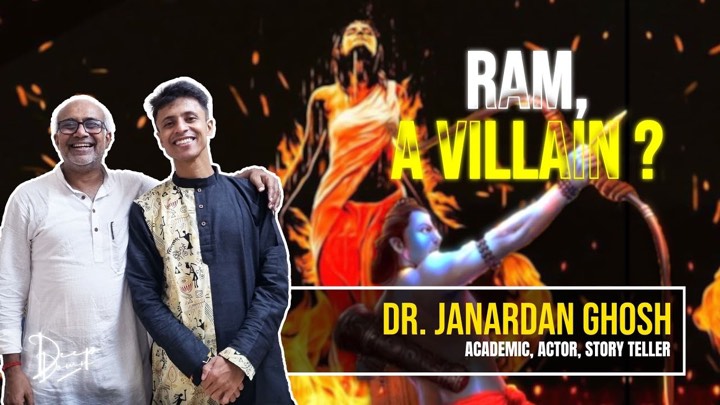
For an audience raised on one version of the Ramayan — Ram as unambiguous hero, Ravan as unambiguous villain — this episode is an argument for treating the epic as literature with a history, not a single closed text. Whether or not a listener accepts Pyne's specific theories, the episode's real case is that questioning a scripture's edges, respectfully and with sources, is itself part of engaging with it seriously. For more on how differently the Ramayan has been read across scholars and storytellers, see Deep Down Show's conversation with Dr. Janardan Ghosh on the controversial sides of the Ramayan, and his earlier episode on spirituality versus religion.
Frequently asked questions
Who is Akash Pyne?
He is a Bengali author who has written half a dozen books, including the novel Ravanayan, which retells the Ramayan from Ravan's perspective, and a science-fiction novel called Rohani Iskabon.
What is Ravanayan about?
It is Akash Pyne's retelling of the Ramayan centred on Ravan rather than Ram, drawing on multiple regional and historical versions of the epic to present Ravan as a scholar, warrior, musician and ruler rather than only a villain. Pyne describes it as his best-selling book, now going into a second edition.
Does the episode claim Sita was Ravan's daughter?
Pyne presents it as one theory among several, not a settled fact. He cites the Sri Lankan king Dhatusena's Sanskrit text Janakiharan for an account in which an astrologer warns Ravan that a daughter born to him would destroy his lineage, so the infant is abandoned and later found by King Janak while he is ploughing his field — which is how she comes to be called Sita, 'furrow'.
What is the Aryan-Anarya theory of the Ramayan discussed here?
Pyne argues the epic can be read as literature that dramatises a real historical conflict between incoming Aryan settlers and the Anarya (non-Aryan) people already living across the subcontinent, with Ravan cast as a leader of the Anarya side defending his territory.
Is the Lakshman Rekha part of the original Ramayan?
According to Pyne, no. He says the line Lakshman is supposed to have drawn to protect Sita does not appear in Valmiki's Sanskrit Ramayan or in Tulsidas's Ramcharitmanas, and that it enters the story later, through regional and folk retellings such as the Maithili Ramayan.
Why is Ravan worshipped in some places?
Pyne points to Ravan temples and traditions in the Mithila region (spanning parts of Nepal and Bihar), eastern India and Sri Lanka, arguing that communities honour his scholarship, his skill in the arts, and his devotion to Shiva even while rejecting his abduction of Sita.
What backlash did Ravanayan receive?
Pyne says the book's reading of Ravan proved controversial enough that the Vishwa Hindu Parishad filed a complaint against him, and he received threats from people linked to the party currently running the central government, alongside strong reactions from some readers online.