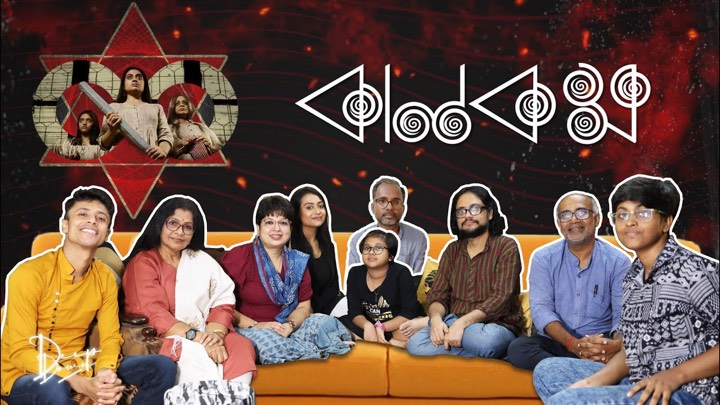
Barun hands over a spoon. Subhrajit Das — better known by his stage name, The Wizard SD — asks him to hold it loosely and feel for something passing between their hands. Seconds later, the spoon bends. It is the kind of moment Deep Down Show's 15th episode is built around: a trick that looks impossible, followed immediately by an explanation of exactly why it isn't.
Subhrajit is a mentalist and illusionist, and this conversation is less a magic show than an attempt to walk back every "supernatural" claim to something explainable — wavelengths, dopamine, memory, nervous-system quirks — while still leaving room for the parts even he won't fully close the door on, like bhoot dhorechhe (being "possessed"). Barun keeps steering him back to the questions people actually ask each other after midnight: why do meaningless dreams feel so real, does Bageshwar Baba really have power, can porn wreck your ability to study.
What makes the episode worth watching isn't a single big reveal — it's that Subhrajit performs the trick, then immediately shows his own seams. He treats every demonstration as a teaching moment about how easily belief, expectation and a bit of stagecraft can be mistaken for something paranormal.
Mentalism vs Magic: Two Different Toolkits
Barun opens with the obvious question — what's the actual difference between mentalism and magic? Subhrajit starts by taking apart the word "magic" itself, tracing it to old traditions built around trickery and sorcery, and pointing out the practice is far older than most people assume. His distinction, running through the rest of the episode, is really about the toolkit: classic magic leans on props, sleight of hand and misdirection, while mentalism leans on reading people — body language, psychology, suggestion — to make it look like minds, not objects, are being manipulated.
Spoon-Bending Telekinesis: What's Really Happening in Your Hand
The centerpiece demonstration — also cut as a separate clip, "Ring Telekinesis, science behind mentalism," on the DDS Clips channel — has Subhrajit holding Barun's hand before the spoon visibly bends. On camera, he talks Barun through feeling a current, a kind of static energy, moving between them, building trust before the "energy" is transferred.
Once the moment passes, he's upfront about the mechanics: there's no special spoon. An ordinary one is worked back and forth until the metal fatigues and gives way — a basic property of metal, not of the performer. What a participant actually feels, he argues, is mostly their own nervousness and anticipation, primed by the buildup and the physical contact, not a genuine current of paranormal energy.
Why Bulls "Hate" Red — and What Colours Do to Us
From telekinesis, the conversation moves into colour. Subhrajit uses the popular belief that bulls charge at red out of rage to introduce a simpler idea: colour is just light at different wavelengths and frequencies, and different frequencies carry different energy levels that our bodies and brains respond to — not only visually, but the way we respond to smell or a scent we associate with a memory. He extends this into everyday colour psychology: blue tends to read as calming, he says, while black registers to the brain as a colour tied to status and seriousness — associations most people carry without ever examining why.
The same segment touches on colour blindness, which he notes shows up more often in men than in women, framing it as a reminder that even something as basic as "seeing red" isn't identical from one brain to the next.
Deja Vu, Memory, and a Two-Minute Fix for Concentration
Asked why deja vu feels so uncanny, Subhrajit describes it as the brain flagging a new moment as familiar because it partially matches something already filed away in memory — the sense of "having lived this before" is really a mismatch between what your senses are registering right now and what your memory system half-recognises.
He ties this to a concrete, testable claim about studying: keep your physical position and environment consistent between learning something and recalling it, he says, and forgetting drops by roughly 20% compared to changing your surroundings — which is why students who always study in the same chair, in the same spot, tend to retain more under exam pressure. He also brings up controlled breathing as a lever on focus, suggesting a short, steady breathing exercise of around two minutes can measurably raise concentration.
Cosmic Energy and the Law of Attraction
The conversation's most debatable stretch is on the law of attraction. Subhrajit grounds his argument in a basic physics idea — that energy is never destroyed, only converted — and extends it to thought and emotion: whatever energy you put out, positive or negative, doesn't simply vanish, it transforms and, in his framing, tends to come back. He's careful to note the corollary isn't magical thinking on demand — a person going through real negative circumstances, job loss or personal crisis, isn't manifesting it by "thinking wrong" — but he maintains that staying open to positive energy shapes what follows.
Dreams, Ghosts, and the Body's Wiring
On why we dream nonsense, Subhrajit describes the brain continuing to process leftover data from the day during sleep, often stitching together images and half-memories that don't need to mean anything.
That same idea of the body registering things the conscious mind can't explain carries into the episode's most delicate topic: bhoot dhorechhe, or possession. Subhrajit doesn't offer a flat denial. He describes cases where a person's mood suddenly flips — cheerful to withdrawn, with nothing wrong at work, in a relationship, or at home to explain it — and suggests some of that could be an external energy or frequency acting on the nervous system, without committing to calling it supernatural outright. It's a more careful answer than a simple "ghosts are real" or "ghosts are fake," and it fits his overall approach: treat the experience as real, then look for what could be causing it.
Soul, Vibration, and Why Some People "Click"
The two also get into a more spiritual register — the body storing and releasing energy, meditation calming an overactive nervous system, and the seven chakras as a traditional framework for that energy moving through the body. Subhrajit uses the idea of "vibration matching" to explain why some friendships or connections feel instant: two people's energy, in his framing, syncing up in a way neither can fully articulate.
Pornography, Dopamine, and Losing the Ability to Focus
One of the episode's more practical stretches deals with a very concrete problem: why some people can't sit still to study anymore. Subhrajit connects heavy pornography and short-video consumption to dopamine tolerance — the brain gets used to fast, intense hits of stimulation and needs progressively more to feel the same reward, which makes slower payoffs like studying or reading feel unbearably dull by comparison. His suggested reset isn't dramatic: morning walks, time around greenery, yoga and meditation, aimed at lowering that baseline stimulation need rather than fighting it head-on with willpower alone.
Card Tricks, ESP Symbols, and the Bageshwar Baba Question
Barun eventually pushes Subhrajit on godmen like Bageshwar Baba, who claims to know visitors' problems without being told. Rather than issuing a verdict on any specific individual, Subhrajit answers with demonstrations: a card-guessing trick where he correctly names Barun's card, and a rundown of ESP test symbols — the standard circle, cross, square and star shapes long used in parapsychology experiments — to show how "mind reading" claims are, at least in principle, testable rather than something to take purely on faith. He's also candid that a lot of what circulates online as "real" mind reading is staged, and that AI-generated content is now muddying the waters further.
Who is Subhrajit Das (The Wizard SD)
Subhrajit Das performs as The Wizard SD, a mentalist and illusionist based in Kolkata. Beyond the stage, he hosts the show Ankur on Doordarshan and is part-director at Hasiwala & Company, which airs on Star Jalsha. He founded Fashion Fuss Production and runs the Suvrankan Art Academy at Padatik Club, Lord's More, Kolkata, and is preparing to release a film, Dhushar Swapno (ধূসর স্বপ্ন). Toward the end of the episode, he previews a future collaboration with Dr. Papiya Mukherjee on chroma therapy and sound therapy — a sign that his interest in the science behind unexplained experience extends past the mentalism stage.
Why This Conversation Matters
Most conversations about magic and the supernatural pick a side — debunker or believer. This one is more useful precisely because Subhrajit refuses to fully commit to either. He'll walk you through exactly how a spoon bends and why a card trick works, and in the same breath admit that sudden mood shifts or a persistent sense of deja vu don't have a tidy, fully-settled explanation yet. For anyone raised on WhatsApp forwards about godmen and ghost stories, that mix of technique and honest uncertainty is a more durable habit of mind than either blind belief or blanket dismissal.
For more on where belief, meaning and everyday life intersect, see the Deep Down Show conversation on spiritual vs religious life with Dr. Janardan Ghosh, or the making of a homegrown thriller in Kalkokkho: House of Time. The spoon-bending demonstration from this episode is also up as a standalone clip on the DDS Clips channel.
Frequently asked questions
Who is The Wizard SD?
The Wizard SD is the stage name of Subhrajit Das, a Kolkata-based mentalist and illusionist. He hosts the show Ankur on Doordarshan, is part-director at Hasiwala & Company on Star Jalsha, and runs Fashion Fuss Production and Suvrankan Art Academy at Padatik Club, Lord's More, Kolkata.
Is mentalism the same as magic?
In this episode Subhrajit treats them as related but distinct crafts. Both engineer a sense of wonder, but he traces the word 'magic' to old traditions of trickery and sorcery built around props and misdirection, while mentalism leans more on psychology, suggestion and reading people.
How does the spoon-bending trick actually work?
Subhrajit says there is no special spoon — an ordinary one is worked back and forth until the metal fatigues and gives way. He argues the 'energy' a participant feels passing through their hand in the moment is mostly their own anticipation and trust, not a paranormal current.
What does the episode say about deja vu and memory?
He frames deja vu as the brain flagging a new moment as familiar because it partially matches something already stored in memory, and connects it to how a consistent study environment or body position can measurably reduce forgetting.
Does the episode say ghosts and possession are real?
Subhrajit does not issue a flat denial. He describes 'bhoot dhorechhe' cases as sudden, unexplained shifts in mood or behaviour with no obvious trigger in a person's job, relationship or family life, and suggests external energy or frequency effects on the nervous system could be part of the picture.
What does the conversation say about pornography and focus?
He connects heavy pornography and short-video consumption to dopamine tolerance — the brain needs increasingly strong stimulation and starts finding slower rewards like studying less satisfying — and suggests morning walks, time in green spaces, yoga and meditation to help reset that baseline.
Does the episode take a position on godmen like Bageshwar Baba?
Rather than ruling on any one individual, Subhrajit demonstrates how mind-reading effects — including a live card-guessing trick and a rundown of ESP symbol tests — can be built from observation and technique, arguing that feats billed as supernatural should be treated as testable rather than taken on faith.