On a December morning in Kolkata, Satadeep Saha did something no other exhibitor in the city was doing. He put a 9:30 am show of Marco, a Hindi-language action release, on the screen at Globe cinema. He did not have to ask anyone; the film was his to distribute. The show went houseful. He informed Mumbai that the film was going to pick up. Three weeks later Marco was running in 65 theatres across Bengal.
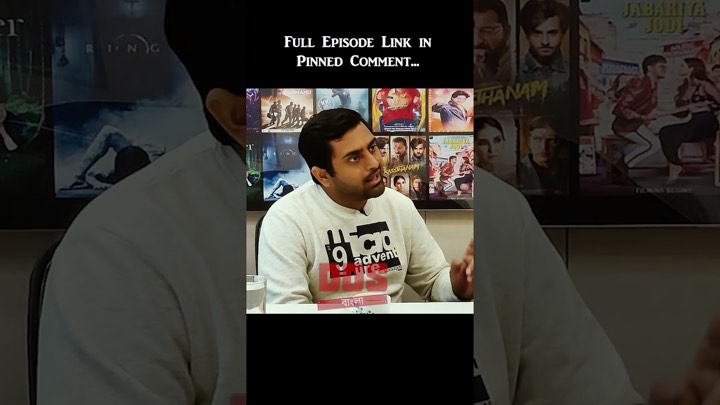
That story is the heart of episode 20 of the Deep Down Show, the বাংলা পডকাস্ট hosted by Barun Kumar Choudhury. The guest is Satadeep Saha, owner of SSR Cinemas, the family business behind halls such as Ajanta and Globe, and a distributor who says he has released more than 500 films. Barun sets the tone at the start: this is not a deep dive into one man's journey but an আড্ডা about why Khadaan, Pushpa 2 and Marco became blockbusters, how ফিল্ম ডিস্ট্রিবিউশন actually works, why South Indian films took over Bengal's screens, and what Saha calls the "নোংরামি" in Bengali film distribution.
For anyone who loves বাংলা সিনেমা and wonders why the industry keeps saying "stand by Bengali films" while halls stay half empty, this is a rare look from the other side of the box-office window.
Pre-Khadaan and post-Khadaan
Barun opens with the obvious question: Dev has asked people to stand by Bangla cinema for years, so has Khadaan finally changed that? Saha's answer is that the industry needs a new calendar.
"যেরকম প্রি-কোভিড, পোস্ট-কোভিড, সেরকমই হওয়া উচিত প্রি-খাদান, পোস্ট-খাদান।"
Satadeep Saha
Just as we speak of pre-Covid and post-Covid, he says, Bengali cinema should now speak of pre-Khadaan and post-Khadaan. Before it, commercial Bangla films were made in one mould; after it, the industry is moving in a different direction.
Why did it work? Saha's first reason is time. Dev worked on the film for a long time; had he shot it in 10 or 15 days the result would have been different. He is scathing about the pre-Khadaan habit of seven-, eight- and ten-day shoots: when scenes are rushed the editor has nothing to cut with, there are no alternative angles, and nothing can look larger than life, because lighting, camera and trolley setups take time. Such films may click on OTT, he says, but rarely in a hall, because audiences now judge a film from its trailer.
His second reason is marketing. Dev's campaign, touring all of Bengal by bus with the full cast and crew, was in his words "fantastic". His line to producers is simple:
"ভালোভাবে ছবি বানাও, ভালো করে মার্কেটিং করো।"
Satadeep Saha
Make the film well and market it well, he says, and the audience for commercial Bengali cinema is there. Songs matter too: the Kishori song had racked up enormous views, and when Dev played him the music of another track, Saha says he told him to release it immediately because it would lift the film another step.
The third reason is show timing. For the first two or three days tickets were unavailable and late-night shows went houseful. The industry used to assume Bengali films run only between 3 pm and 7 pm, which excludes everyone who gets home from office at 8:30. SSR had already tried morning shows for Tekka and they worked. His conclusion: the public does not come for a show time, it comes for a film it wants to see.
Barun pushes back gently, saying the first half could have been tighter and he wanted more of the father's character. Saha half agrees, but says what matters is that people came and enjoyed themselves, and claims Khadaan 2 will have a stronger story, with more of the father's track.
What a film distributor actually does
Barun admits most viewers have no idea what distribution means, so Saha lays it out. A distributor takes the film from the producer and gets it to the halls. He decides, partly, when it plays and at what ticket rate, and if an area has three halls, which one gets which film. He also has to return the producer's money on time and sit with producers to explain honestly what a film can and cannot do.
"কিছুটা প্রেডিকশনের খেলা এটা… কিছু সময় আমরা ঠিক থাকি, কিছু সময় আমরা ভুল হতে পারি।"
Satadeep Saha
It is largely a game of prediction, he says; sometimes they are right, sometimes wrong.
Because Saha is distributor, exhibitor and producer at once, Barun asks whether his own halls favour his own films. Saha says there was some of that when he started, but emotion has no place in a business that has released this many films. In his own halls he will cut his own film's shows if another is selling better.
"যদি চলে, আমি ১০টা শো-ই বাংলা সিনেমা দিতে রাজি আছি, কিন্তু চলতে তো হবে।"
Satadeep Saha
If a Bengali film runs, he is happy to give it all ten shows, but it has to run. Language is not the point; the point is which film will sell.
The Marco experiment and a December of four Bengali hits
The Marco numbers are the most concrete in the episode. Baby John had released on 25 December to mixed or bad reports, so Marco replaced it. In its first week Marco played at eight centres in Bengal with a total collection of roughly 47,000 rupees. In the second week, from the Wednesday or Thursday, it collected around 12 lakh and expanded to 34 cinemas. By the Friday of the third week it was in 65 theatres. Even the all-India distributor, he says, did not realise the film was a hit until week three; the demand came entirely from the public.
The same December produced something Saha says never happens: from 20 December four Bengali films, Khadaan, 5 No. Swapnamoy Lane, Shontaan and Chaalchitro, all ran well at once. His estimate is that 80 to 85 percent of festive-season viewers watched more than one, and the winner was the industry. At Globe, a hall where he had never imagined Bengali films drawing queues, people lined up for Khadaan, 5 No. Swapnamoy Lane and Bohurupi. Even so, he would rather have fewer simultaneous releases, because a single screen cannot give four films enough shows. When the public says Bengali films are denied shows, he replies that if a film sells, shows are added, never cut.
The dirty politics nobody will name
Then comes the part Barun flags in the teaser. Saha says a group in the industry has kept this নোংরামি going for 20 to 25 years, since before he entered distribution. Once, only one or two production houses' films got good shows, and the public never understood why. The same people, he says, at one time stood Bengali cinema on its feet and at another time hurt it. Even Dev, when he first released a film from his own production house, struggled to find halls.
"ওই দু-চারজন যারা এই বদমাইশিগুলো করে, তাদেরকে যদি চেঞ্জ করে দেওয়া হয়, কালকের থেকে বাংলা সিনেমার মানচিত্র চেঞ্জ হয়ে যাবে।"
Satadeep Saha
Replace the two or four people responsible, he says, and the map of Bengali cinema would change from tomorrow. When Barun points out that nobody will name these people openly, Saha agrees it needs to be said. As an example he describes a single-screen owner who, the previous weekend, admitted refusing to play Chengiz because he did not get along with the star. Saha calls it very wrong: an exhibitor's job is to run everyone's film and let the public judge, because a producer who never gets a chance never survives, and then the next film is never made.
On stars opening production houses, Saha rejects Barun's word "nepotism". It is about freedom: producing your own film means telling your own story your own way, with your own team. He corrects the idea that Jeet started producing because he was frozen out, noting that Jeet's production house is the oldest among today's stars and that Soham has opened one only recently. Barun adds what Dev has said in interviews: he did not want to make remakes, and had watched his film Dhumketu fail to release. Both agree the industry needs more massy heroes beyond Dev, Jeet, Ankush and Vikram, and Saha wants producers willing to bet on new faces.
Why the South won: "we established them ourselves"
Barun asks why Bengalis love the story in a Hindi or South film but call the same story weak in Bengali. Saha's first answer is language: Bengalis understand Hindi, so they compare everything with Hindi, whereas the South does not. His second is budget, with a twist.
"পাঁচ কোটি টাকায় আমি কী করে ২৫ কোটি টাকার বাজেট দেখাবো, সেইটাই হচ্ছে চ্যালেঞ্জ।"
Satadeep Saha
The challenge is how to make a five-crore film look like a 25-crore one, and the answer is time: a year of scripting, narrations heard ten times over, real locations instead of the old Tollygunge sets. When the Malayalam film Aavesham comes up, a film Bengalis watched in Malayalam with subtitles before it was dubbed into Hindi, both agree that one strong story can change a film's fate.
On how the South took over, Barun offers a theory and Saha endorses it: Bengal built that audience itself. Nobody here knew who Allu Arjun was until years of dubbed South films on channels like Set Max, watched because there was no Bengali alternative; Saha adds that it was 10 to 15 years of effort, not something that happened in a day. Bollywood started making multiplex-oriented films, while the South kept the songs, dance and action mass audiences wanted, so viewers began waiting for a hero's next film even in Telugu with subtitles.
His own ledger shows the price of that shift. Three or four years ago, dubbed South films could be bought in Mumbai for 50,000 or 60,000 rupees. He picked up a Yash film called Rambo, before he knew who Yash was, for 60,000, and it returned a share of three and a half to four lakh in Bengal. The same star's film today would cost a minimum of five to six crore. District single screens wanted action, and an Akshay Kumar film like Airlift could not run there, so cheap South action filled the gap until Baahubali 2 rewrote the rate card. If a Bengali film could go from 60,000 to even six lakh, he argues, the industry would be far ahead.
Satellite money, gross numbers and the missing calendar
Why did people think only art-house Bangla films could run? Saha traces it to money. A producer recovers from theatrical, music rights and satellite-digital sales, and when TV channels stopped buying Bengali films that large portion vanished, leaving theatrical alone, which cannot return an investment.
"প্যাশন খুব ভালো, বাট প্যাশন দিয়ে তো সবসময় হয় না… আল্টিমেটলি ইট ইজ বিজনেস।"
Satadeep Saha
Passion is fine, he says, but it does not always pay; ultimately this is a business. He believes the satellite market is stuck because of tie-ups and mergers in Mumbai, and that the day it reopens, alongside today's healthy theatrical numbers, Bengali production values will rise again. Readers interested in how small Bengali films survive without that money should also read the episode on Kalkokkho and low-budget filmmaking.
Barun also asks about the "600 crore" attached to films like Dunki. Saha explains that the headline number is not what the producer earns: GST, tax, TDS and the hall owner's share come off first, some studios report gross and some net, and the figures exist mainly to tell the public a film is drawing crowds.
The release calendar is another sore point. Bollywood and the South publish a year's line-up, spacing big films with at most two or three on one day. In Bengal, Saha says, EIMPA, the Eastern India Motion Picture Association, should do this, since every producer must take its membership to release a film, but it does nothing.
"ইম্পা বিল্ডিংটা আছে, বডিটা ইন্যাক্টিভ।"
Satadeep Saha
The EIMPA building exists, he says, but the body is inactive. Producers pick dates in their own offices and five films land on one day. He remembers the first Puja after Covid, when 11 Bengali films released in the week of SOS Kolkata; no viewer can watch more than three or four. His proposal is a cap of three films even at Puja.
Running halls: renovate every seven years
Barun raises a Durgapur puzzle: SSR's hall there looked emptier on BookMyShow than a rival cinema. Saha's answer is capacity: the rival has 100 to 150 seats, so 100 people make it houseful, while his screens seat around 350. He took over the Durgapur property from Carnival a year earlier; it had been dark for a long time and had changed hands before, so people had lost trust in the location. The first months were slow, but it now runs well. It has 990 seats across three screens and he plans to renovate one screen at a time so the property never closes. Carnival, he says, took over halls without investing a rupee in them.
That is his rule for exhibitors: what remains after salaries, rent and electricity is not profit, because every seven or eight years a hall must be renovated, from seats and carpets to screen and sound. Single screens died because they were built once and never changed while technology moved from reels to digital projection. SSR runs 32 screens in West Bengal and Tripura, with two screens opening at Amtala, two above a mall in Basirhat, a cinema mall in Ashoknagar and screens in Bolpur under way; he is aiming for about 50. Bengal has a little over 200 screens today, and he expects close to 250 within three years. His advice to anyone building a mall: put the cinema on the top floor with a minimum height of 18 to 20 feet, because many Kolkata malls skipped that and lost a business that is there for the taking. Like the entrepreneurs in the Chowman restaurant episode, he treats reinvestment, not withdrawal, as the point of profit.
Why Baby John flopped
Barun notes Saha had been publicly hopeful about Baby John. His post-mortem: distributors in Mumbai were shown 25 to 29 minutes of footage that turned out to be the film's best portions, mostly the present-day track of Varun Dhawan protecting his daughter. The teaser created a high; the trailer dropped it and interest never grew. The film was a frame-by-frame remake of Theri, which Saha had seen, at a time when audiences no longer want remakes. It ran three hours with six songs when four would do, and it opened while Pushpa 2 was still sweeping the box office, which everyone knew would happen after part one. For a distributor, he adds, these are guesses made before release; nobody can be sure a film will run.
Cricket, Jaani Dushman and a marriage that took three years
The lighter half of the আড্ডা reveals the man. Saha still plays serious cricket, with a match the day after the shoot; a friend of Barun's recognised him as a cricketer, not a distributor. A cricketer's prime lasts until 35 or 40, he says, while a business runs all your life, so everyone should keep two options. His father played badminton and produced films, including with Chiranjeet, and the family owned Ajanta cinema, so Saha grew up watching prints being bid for hall by hall. He remembers the disappointment when Koi... Mil Gaya went to a neighbouring hall. His first film alone was Jaani Dushman at Ashoka cinema: his father dropped him on a scooter, he counted out 50 rupees and sat in the balcony, around class two, three or four. Barun, by contrast, grew up in Buniadpur in Dakshin Dinajpur, passing the Gouri and Sandhya cinemas on his school van.
His marriage was arranged-cum-love: a matrimony contact, then Facebook, a reply after a month, and three years of convincing a family that believed "cinema line" people are not trustworthy. They married six years ago. Asked why his profile ends with the word "honest", he says he plays cricket and does business the same way, which is why he has plenty of enemies in the market, and why he can come through any situation. His favourite Marvel hero is Captain America, because he leads without any powers.
Who is Satadeep Saha
Satadeep Saha runs SSR Cinemas, the family exhibition, distribution and production business whose Kolkata halls include Ajanta and Globe. He studied from KG to class 12 at Apeejay School on Park Street, did a B.Com at Heramba Chandra College and an MBA from Sikkim Manipal, and never planned to join the business. He says he has released more than 500 films and operates 32 screens in West Bengal and Tripura. He was a distributor on 5 No. Swapnamoy Lane but asked for his name as producer after watching it, and took on Dostojee for love of the film. Distribution and exhibition remain his first priority; he will produce only when a script is genuinely lucrative, and he says he is willing to help anyone who wants to open a hall or enter distribution.
Why this conversation matters
Most conversations about বাংলা সিনেমা happen between fans and stars. This one happens with the person who decides which film plays at 9:30 am in Globe, and it replaces slogans with numbers: 47,000 rupees to 65 theatres for Marco, four Bengali hits in one December, a 60,000-rupee South film that now costs six crore, 32 screens becoming 50. Saha's argument is that Bengali cinema's problems are specific and fixable, whether ten-day shoots, an inactive EIMPA, a dead satellite market or a handful of people playing politics with shows. If you have wondered why Bengalis are said not to do business, here is a Bengali running a 500-film business who insists the audience was never the problem. Watch the full episode, and find the teaser on the DDS Clips channel.
Frequently asked questions
Who is Satadeep Saha?
Satadeep Saha is a Kolkata-based film exhibitor, distributor and producer who runs SSR Cinemas, the family business behind halls such as Ajanta and Globe. He studied at Apeejay School on Park Street, did a B.Com at Heramba Chandra College and an MBA from Sikkim Manipal, and says he has released more than 500 films. He still plays cricket seriously.
Why did Khadaan become such a big hit according to Satadeep Saha?
He credits Dev's long, unhurried work on the film rather than a 10-day shoot, a marketing campaign that toured all of Bengal by bus with the full cast and crew, hit songs like Kishori, and a story that gave every kind of audience a reason to come. Tickets were unavailable for the first two or three days, late-night shows went houseful and morning-show experiments worked, which he calls a very good sign for Bangla cinema.
How does film distribution work in Bengal?
A distributor takes the film from the producer and supplies it to cinema halls, deciding which hall in an area gets it, at which show times and at what ticket rate. The distributor also has to return money to the producer on time and advise on what a film can realistically do. Saha calls it largely a game of prediction, where you are sometimes right and sometimes wrong.
Why did Marco get so many shows in Bengal?
Baby John released on 25 December to mixed or poor reports, so Marco replaced it. Saha ran an experimental 9:30 am show of Marco at Globe that went houseful, then informed Mumbai that the film would pick up. In the first week it played at 8 centres; by the second week it was on 34 screens with about Rs 12 lakh collected mid-week, and by the third Friday it was running in 65 theatres.
Why do Bengali films not get shows in cinema halls?
Saha says if a Bengali film sells, he never cuts its shows and instead adds them; language does not matter, only whether the film runs. But he also says a small group in the industry has practised dirty politics for 20 to 25 years, favouring one or two production houses, and even Dev struggled to get halls when he first produced his own film.
Why did Baby John flop?
According to Saha, the 25 to 29 minutes of footage shown to distributors in Mumbai contained the film's best portions, the teaser created a high that the trailer then killed, audiences no longer want remakes, the film was a three-hour frame-by-frame copy with six songs where four would do, and it released while Pushpa 2 was still dominating.
What is the problem with the Bengali film release calendar?
Saha says EIMPA, the Eastern India Motion Picture Association, should prepare a year-long release line-up as happens in Bollywood and the South, but the body is inactive. Producers decide dates in their own offices, so five films can land on one day; he recalls a post-Covid Puja week when 11 Bengali films released together. He suggests a maximum of three films even at Puja.